How Much Ram Can Be Installed in Either Datacenter or Standard Editions of Windows Server 2012?
Windows Server 2012 Editions
 On the ist of Baronial, 2012 Microsoft released Windows Server 2012– the sixth release of the Windows Server production family. On May 21st 2013, Windows Server 2012 R2 was introduced and is now the latest version of Windows Server in the market. Microsoft has released four dissimilar editions of Windows Server 2012 varying in cost, licensing and features. These four editions of Windows Server 2012 R2 are: Windows 2012 Foundation edition, Windows 2012 Essentials edition, Windows 2012 Standard edition and Windows 2012 Datacenter edition.
Let's accept a closer wait at each Windows Server 2012 edition and what they have to offer.
Users can as well download the free Windows Server 2012 R2 Licensing Datasheet in our Windows Server Datasheets & Useful Resources download section, which provides a detailed overview of the Licensing for Windows Server 2012 and contains extremly useful information on the various Windows Server 2012 edition, examples on how to summate your licensing needs, Virtualization instances supported by every edition, server roles, mutual questions & answers, plus much more.
More technical articles roofing Windows 2012 Server and Hyper-V Virtualization are available in our Windows 2012 Server section.
Windows Server 2012 Foundation edition
This edition of Windows Server 2012 is targeted towards small businesses of up to 15 users. The Windows Server 2012 R2 Foundation edition comes pre-installed on hardware server with unmarried physical processor and up to 32GB of DRAM retentiveness. Foundation edition can exist implemented in environments where features such as file sharing, printer sharing, security and remote access are required. Advanced server features such every bit Hyper V, RODC (Read Only Domain Controller), data deduplication, dynamic memory, IPAM (IP Address Management), server cadre, certificate service function, hot add together memory, windows update services and failover clustering are not available in the Foundation edition.
Windows Server 2012 Essentials edition
The Windows Server 2012 R2 Essentials edition is the next footstep up, also geared towards pocket-size businesses of up to 25 users.Windows Server 2012 R2 Essentials edition is available in retail stores effectually the world making it easy for businesses to install the new operating organization without necessarily purchasing new hardware. Like to the Foundation edition, the Essentials edition does not support many avant-garde server features, however it does provide support of features like Hyper V, dynamic memory and hot add/remove RAM.
Windows Server 2012 R2 Essentials edition can run a single example of virtual machine on Hyper Five, a feature that was not available in Windows Server 2012 Essentials (not-R2) edition. This single virtual auto instance tin can exist Windows Server 2012 R2 Essential edition only, seriously limiting the virtualization options only allowing companies to begin exploring the benefits of the virtualization platform.
Windows Server 2012 Standard edition
The Windows Server 2012 R2 Standard edition of windows server is used for medium to large businesses that require additional features not present in the Foundation & Essential edition. The Standard edition is able to support an unlimited corporeality of users, as long every bit the required user licenses have been purchased.
Advanced features such equally document services role, Hyper V, RODC (Read But Domain Controller), IPAM (IP Address Management), Information deduplication, server core, failover clustering and more than, are available to Windows Server 2012 Standard edition. Nosotros should note that the Standard edition supports upwardly to 2 Virtual Machines.
Windows Server 2012 Datacenter edition
The Windows Server 2012 R2 Datacenter edition is the flagship product created to meet the needs of medium to large enterprises. The major difference between the Standard and Datacenter edition is that the Datacenter edition allows the cosmos of unlimited Virtual Machines and is therefore suitable for environments with extensive use of virtualization technology.
Before purchasing the Windows Server 2012 operating system, it is very important to empathize the deviation between various editions, the tabular array below shows the difference betwixt the iv editions of Windows Server 2012:
| Editions | Foundation | Essentials | Standard | Datacenter |
| Distribution | OEM Only | Retail, volume licensing, OEM | Retail, volume licensing, OEM | Volume licensing and OEM |
| Licensing Model | Per Server | Per Server | Per CPU pair + CAL/DAL | Per CPU pair + CAL/DAL |
| Processor Chip Limit | 1 | 2 | 64 | 64 |
| Memory Limit | 32GB | 64GB | 4TB | 4TB |
| User Limit | fifteen | 25 | Unlimited | Unlimited |
| File Services limits | 1 standalone DFS root | 1 standalone DFS root | Unlimited | Unlimited |
| Network Policy & Access Services limits | 50 RRAS connections and 10 IAS connections | 250 RRAS connections, 50 IAS connections, and 2 IAS Server Groups | Unlimited | Unlimited |
| Remote Desktop Services limits | 50 Remote Desktop Services connections | Gateway only | Unlimited | Unlimited |
| Virtualization rights | n/a | Either in ane VM or 1 physical server, but not both at once | 2 VMs | Unlimited |
| DHCP, DNS, Fax server, Printing, IIS Services | Aye | Yes | Yes | Yes |
| Windows Server Update Services | No | Yes | Yeah | Yes |
| Active Directory Services | Yes, Must be root of forest and domain | Yes, Must be root of wood and domain | Aye | Yes |
| Active Directory Certificate Services | Certificate Authorities but | Certificate Authorities only | Aye | Yeah |
| Windows Powershell | Yes | Yes | Yes | Yep |
| Server Core fashion | No | No | Yes | Aye |
| Hyper-5 | No | No | Yep | Yes |
Windows Server 2012 Licensing - Understanding Client Admission License (CAL) and Device Access License (DAL) Licensing models
The standard and datacenter editions of Server 2012 back up Customer Access License (CAL) or Device Access License (DAL) licensing model. A CAL license is assigned to a user whereas a DAL license is assigned to device (figurer). For example, a CAL assigned to a user, allows only that user to access the server via any device. Likewise, if a DAL is assigned to particular device, then any authenticated user using that device is allowed to access the server.
We can use a simple example to help highlight the practical differences between CAL and DAL licensing models and understand the nearly cost-effective arroyo:
Assume an environment with Windows Server 2012 R2 standard edition and a full of 50 users and 25 devices (workstations). In this example, we can purchase either l CAL licenses to encompass the 50 users nosotros have or alternatively 25 DAL licenses to cover the full amount of workstations that need to access the server. In this scenario, purchasing DALs is a more cost effective solution.
If however we had 10 users with a full of xx devices , e.m 2 devices per user (workstation & laptop), and then it more be more cost constructive to purchase ten CAL licenses.
Windows Server 2012 Foundation Edition Licensing Model
Windows Server 2012 Foundation is available to OEMs (Original Equipment Manufacturers) only and therefore tin simply exist purchased at the time of purchasing a north new hardware server. Windows 2012 Foundation edition supports up to xv users. CALs or DALs are non required for the Foundation edition servers. In addition, Foundation edition owners cannot upgrade to other editions. The maximum number of SMB (Server Message Block or file sharing) connections to the server is 30. Similarly, maximum number of RRAS (Routing and Remote Access Service) and RDS (Remote Desktop Service) connections is fifty.
Windows Server 2012 Essentials Edition Licensing Model
The Essential edition of server 2012 is available to OEMs (with the buy of new hardware) and also at retail stores. The user limit of this server edition is 25 and device limit is 50. This means that a maximum of 25 users amidst fifty computers can access the Windows Server 2012 Essentials edition. For case, you have 20 users rotating randomly amongst 25 computers accessing the Server 2012 Essentials edition, without any problem. CALs or DALs are non required for Windows Server 2012 Essentials edition considering no more than than 25 users tin access the server.
A common question at this point is what if the organization expands and increases its users and computers?
In these cases Microsoft provides an upgrade path allowing organizations to upgrade to the Windows Server 2012 Standard or Datacenter edition license and perform an in-identify license transition. Once the transition is complete, the user limitation, and other features are unlocked without requiring migration or reinstallation of the server.
Companies upgrading to a higher edition of Windows 2012 Server should keep in mind that information technology will be necessary to purchase the required amount of CALs or DALs according to their users or devices.
Administrators will be happy to know that information technology is also possible to downgrade the Standard edition of Server 2012 to the Essentials edition. For example, information technology is possible to run Essential edition of Server 2012 as virtual machine utilizing ane of two bachelor virtual instances in Standard edition equally shown in the figure below. This eliminates the needs to purchase Essential edition of Server 2012.
Free Hyper-V & VMware Virtualization Backup: Costless for Firewall.cx readers for a Limited Time! Download Now!
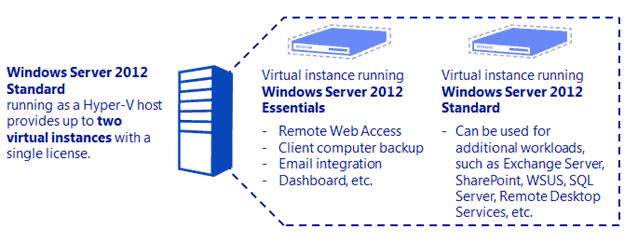
With the release of Windows Server 2012 Essentials R2, Microsoft has updated its licensing model. Dissimilar Windows Server 2012 Essentials (non-R2), y'all can now run a single case of a virtual machine.
The Hyper-V office and Hyper-Five Manager console are at present included with Windows Server 2012 R2 Essentials. The server licensing rights have been expanded, assuasive you lot to install an instance of Essentials on your concrete server to run the Hyper-V function (with none of the other roles and features of the Essentials Experience installed), and a second instance of Essentials equally a virtual machine (VM) on that aforementioned server with all the Essentials Feel roles and features.
Windows Server 2012 Standard Edition and Datacenter Edition Licensing Model
The license of Standard and Datacenter edition is based on sockets (CPUs) and CAL or DAL. Definition of a socket is a CPU or physical processor. Logical cores are not counted as sockets. A unmarried license of Standard and Datacenter edition covers up to 2 physical processors per physical server. CAL or DAL licenses are and then required so that clients/devices can access the Windows server. Standard edition allows up to two virtual instances while the Datacenter edition allows unlimited number of virtual instances.
For instance, a Windows 2012 Server R2 Standard edition installed on a physical server with ane socket (CPU) tin support up to 2 instances of virtual machines. These virtual machines tin can be Server 2012 R2 Standard or Essentials edition. Similarly, if you install a Windows Server 2012 R2 Datacenter edition, then you can install an unlimited number of virtual machines.
Let's await at some examples on deploying Standard and Datacenter edition servers and computing the licenses required:
Scenario 1: Install Server 2012 Standard/Datacenter Edition on a server box with iv physical processors and 80 users.
In this scenario, we will be required to purchase ii Standard/Datacenter Edition licenses considering a unmarried license covers up to two physical processors, plus 80 CAL licenses so our users tin can access the server resources.
Scenario two: Install Server 2012 Standard Edition on a concrete server with 1 physical processor, running viii instances of virtual machines. A total of 50 users volition be accessing the server.
Here, four Server 2012 Standard edition licenses are required and 50 CALs or DALs. Remember that a single Standard edition license covers up to two physical processors and upward to two instances of virtual machines. Since the requirement is to run eight instances of virtual machines, nosotros demand four Standard edition licenses.
If we decided to utilise the Datacenter edition in this scenario, a single license with 50 CAL would be enough to cover our needs, because the Datacenter edition license supports an unlimited number of virtual instances and upwards to two physical processors.
Conclusion
Microsoft's Windows Server 2012 is an attractive server-based product designed to run into the demands of minor to large enterprises and has a very flexible licensing model. It is very important to fully empathise the licensing options and supported features on each of the 4 bachelor editions, earlier proceeding with your purchase – a tactic that volition aid ensure costs are kept well within the allocated budget while the company'southward needs are fully met.
Back to Windows 2012 Server Section
Source: https://www.firewall.cx/microsoft-knowledgebase/windows-2012/983-windows-2012-editions-licensing.html
0 Response to "How Much Ram Can Be Installed in Either Datacenter or Standard Editions of Windows Server 2012?"
Post a Comment