Discuss the Change in Micaelangelos Early and Later Art
| Michelangelo | |
|---|---|
 Portrait by Daniele da Volterra, c. 1545 | |
| Built-in | Michelangelo di Lodovico Buonarroti Simoni 6 March 1475 Caprese, Republic of Florence |
| Died | 18 February 1564(1564-02-eighteen) (aged 88) Rome, Papal States |
| Known for | Sculpture, painting, architecture, and poetry |
| Notable piece of work |
|
| Movement | High Renaissance |
| Signature | |
 | |
Michelangelo di Lodovico Buonarroti Simoni (Italian: [mikeˈlandʒelo di lodoˈviːko ˌbwɔnarˈrɔːti siˈmoːni]; 6 March 1475 – xviii February 1564), known simply equally Michelangelo ([i]), was an Italian sculptor, painter, architect and poet of the Loftier Renaissance. Born in the Commonwealth of Florence, his work had a major influence on the development of Western art, particularly in relation to the Renaissance notions of humanism and naturalism. He is often considered a contender for the title of the archetypal Renaissance man, along with his rival and elderberry contemporary, Leonardo da Vinci.[2] Given the sheer volume of surviving correspondence, sketches, and reminiscences, Michelangelo is one of the best-documented artists of the 16th century and several scholars accept described Michelangelo equally the most accomplished creative person of his era.[3] [4]
He sculpted two of his best-known works, the Pietà and David, before the age of 30. Despite property a low opinion of painting, he as well created two of the most influential frescoes in the history of Western art: the scenes from Genesis on the ceiling of the Sistine Chapel in Rome, and The Last Judgment on its chantry wall. His pattern of the Laurentian Library pioneered Mannerist architecture.[5] At the age of 74, he succeeded Antonio da Sangallo the Younger as the builder of St. Peter's Basilica. He transformed the plan and then that the western cease was finished to his design, as was the dome, with some modification, afterward his death.
Michelangelo was the first Western creative person whose biography was published while he was alive.[ii] In fact, two biographies were published during his lifetime. I of them, by Giorgio Vasari, proposed that Michelangelo's piece of work transcended that of any artist living or dead, and was "supreme in not 1 art alone but in all three."[6]
In his lifetime, Michelangelo was often called Il Divino ("the divine one").[7] His contemporaries ofttimes admired his terribilità—his ability to instill a sense of awe in viewers of his art. Attempts by subsequent artists to imitate[viii] Michelangelo'south impassioned, highly personal style contributed to the rise of Mannerism, a brusque-lived mode and menstruation in Western art following the High Renaissance.
Life
Early life, 1475–1488
Michelangelo was born on six March 1475[a] in Caprese, known today as Caprese Michelangelo, a small town situated in Valtiberina,[9] near Arezzo, Tuscany.[10] For several generations, his family had been minor bankers in Florence; simply the bank failed, and his begetter, Ludovico di Leonardo Buonarroti Simoni, briefly took a regime post in Caprese, where Michelangelo was born.[ii] At the time of Michelangelo's nativity, his father was the town's judicial administrator and podestà or local administrator of Chiusi della Verna. Michelangelo's mother was Francesca di Neri del Miniato di Siena.[eleven] The Buonarrotis claimed to descend from the Countess Mathilde of Canossa—a claim that remains unproven, but which Michelangelo believed.[12]
Several months after Michelangelo'southward birth, the family returned to Florence, where he was raised. During his mother's later prolonged illness, and after her death in 1481 (when he was six years one-time), Michelangelo lived with a nanny and her husband, a stonecutter, in the boondocks of Settignano, where his father owned a marble quarry and a small farm.[11] In that location he gained his love for marble. As Giorgio Vasari quotes him:
If there is some good in me, it is because I was born in the subtle atmosphere of your country of Arezzo. Along with the milk of my nurse I received the knack of handling chisel and hammer, with which I make my figures.[10]
Apprenticeships, 1488–1492

As a young boy, Michelangelo was sent to Florence to report grammer under the Humanist Francesco da Urbino.[x] [xiii] [b] However, he showed no involvement in his schooling, preferring to copy paintings from churches and seek the visitor of other painters.[thirteen]
The city of Florence was at that fourth dimension Italy's greatest center of the arts and learning.[fourteen] Art was sponsored past the Signoria (the boondocks council), the merchant guilds, and wealthy patrons such every bit the Medici and their banking associates.[fifteen] The Renaissance, a renewal of Classical scholarship and the arts, had its start flowering in Florence.[fourteen] In the early 15th century, the architect Filippo Brunelleschi, having studied the remains of Classical buildings in Rome, had created two churches, San Lorenzo's and Santo Spirito, which embodied the Classical precepts.[xvi] The sculptor Lorenzo Ghiberti had laboured for l years to create the bronze doors of the Baptistry, which Michelangelo was to describe as "The Gates of Paradise".[17] The outside niches of the Church of Orsanmichele contained a gallery of works by the almost acclaimed sculptors of Florence: Donatello, Ghiberti, Andrea del Verrocchio, and Nanni di Banco.[15] The interiors of the older churches were covered with frescos (mostly in Late Medieval, but also in the Early Renaissance style), begun by Giotto and continued by Masaccio in the Brancacci Chapel, both of whose works Michelangelo studied and copied in drawings.[xviii]
During Michelangelo's childhood, a squad of painters had been chosen from Florence to the Vatican to decorate the walls of the Sistine Chapel. Amongst them was Domenico Ghirlandaio, a master in fresco painting, perspective, figure drawing and portraiture who had the largest workshop in Florence.[15] In 1488, at age thirteen, Michelangelo was apprenticed to Ghirlandaio.[19] The next twelvemonth, his father persuaded Ghirlandaio to pay Michelangelo every bit an artist, which was rare for someone of fourteen.[xx] When in 1489, Lorenzo de' Medici, de facto ruler of Florence, asked Ghirlandaio for his ii best pupils, Ghirlandaio sent Michelangelo and Francesco Granacci.[21]
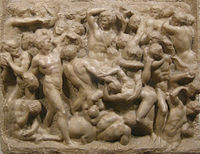
From 1490 to 1492, Michelangelo attended the Platonic University, a Humanist university founded past the Medici. There, his work and outlook were influenced past many of the well-nigh prominent philosophers and writers of the mean solar day, including Marsilio Ficino, Pico della Mirandola and Poliziano.[22] At this time, Michelangelo sculpted the reliefs Madonna of the Steps (1490–1492) and Battle of the Centaurs (1491–1492),[xviii] the latter based on a theme suggested by Poliziano and commissioned by Lorenzo de' Medici.[23] Michelangelo worked for a time with the sculptor Bertoldo di Giovanni. When he was seventeen, another educatee, Pietro Torrigiano, struck him on the nose, causing the disfigurement that is conspicuous in the portraits of Michelangelo.[24]
Bologna, Florence and Rome, 1492–1499

Pietà, St Peter's Basilica (1498–99)
Lorenzo de' Medici'south expiry on eight April 1492 brought a reversal of Michelangelo'south circumstances.[25] Michelangelo left the security of the Medici court and returned to his father's house. In the following months he carved a polychrome wooden Crucifix (1493), as a souvenir to the prior of the Florentine church building of Santo Spirito, which had allowed him to practice some anatomical studies of the corpses from the church's hospital.[26] This was the first of several instances during his career that Michelangelo studied anatomy past dissecting cadavers.[27] [28]
Betwixt 1493 and 1494 he bought a block of marble, and carved a larger-than-life statue of Hercules, which was sent to French republic and subsequently disappeared sometime in the 18th century.[23] [c] On 20 January 1494, subsequently heavy snowfalls, Lorenzo's heir, Piero de Medici, deputed a snow statue, and Michelangelo again entered the court of the Medici.[29]
In the same yr, the Medici were expelled from Florence as the event of the rise of Savonarola. Michelangelo left the city before the cease of the political upheaval, moving to Venice and then to Bologna.[25] In Bologna, he was commissioned to carve several of the terminal small figures for the completion of the Shrine of St. Dominic, in the church dedicated to that saint. At this time Michelangelo studied the robust reliefs carved by Jacopo della Quercia around the main portal of the Basilica of St Petronius, including the panel of The Creation of Eve, the composition of which was to reappear on the Sistine Chapel ceiling.[30] Towards the finish of 1495, the political state of affairs in Florence was calmer; the urban center, previously under threat from the French, was no longer in danger every bit Charles Viii had suffered defeats. Michelangelo returned to Florence only received no commissions from the new city government under Savonarola.[31] He returned to the employment of the Medici.[32] During the half-year he spent in Florence, he worked on two minor statues, a child St. John the Baptist and a sleeping Cupid. According to Condivi, Lorenzo di Pierfrancesco de' Medici, for whom Michelangelo had sculpted St. John the Baptist, asked that Michelangelo "fix it and then that information technology looked equally if information technology had been cached" and so he could "ship it to Rome ... pass [it off as] an ancient piece of work and ... sell it much better." Both Lorenzo and Michelangelo were unwittingly cheated out of the real value of the piece past a middleman. Cardinal Raffaele Riario, to whom Lorenzo had sold it, discovered that it was a fraud, only was so impressed by the quality of the sculpture that he invited the creative person to Rome.[33] [d] This apparent success in selling his sculpture abroad every bit well as the bourgeois Florentine situation may have encouraged Michelangelo to have the prelate's invitation.[32] Michelangelo arrived in Rome on 25 June 1496[34] at the historic period of 21. On 4 July of the aforementioned twelvemonth, he began work on a commission for Cardinal Riario, an over-life-size statue of the Roman wine god Bacchus. Upon completion, the piece of work was rejected by the cardinal, and subsequently entered the drove of the banker Jacopo Galli, for his garden.
In November 1497, the French administrator to the Holy Meet, Central Jean de Bilhères-Lagraulas, deputed him to carve a Pietà, a sculpture showing the Virgin Mary grieving over the torso of Jesus. The discipline, which is not part of the Biblical narrative of the Crucifixion, was common in religious sculpture of Medieval Northern Europe and would have been very familiar to the Key.[35] The contract was agreed upon in August of the post-obit year. Michelangelo was 24 at the time of its completion.[35] It was soon to exist regarded every bit one of the world's great masterpieces of sculpture, "a revelation of all the potentialities and force of the fine art of sculpture". Gimmicky opinion was summarised by Vasari: "It is certainly a phenomenon that a formless block of stone could ever take been reduced to a perfection that nature is scarcely able to create in the mankind."[36] It is now located in St Peter's Basilica.
Florence, 1499–1505

The Statue of David, completed by Michelangelo in 1504, is one of the most renowned works of the Renaissance.
Michelangelo returned to Florence in 1499. The Republic was changing later on the autumn of its leader, anti-Renaissance priest Girolamo Savonarola, who was executed in 1498, and the rising of the gonfaloniere Piero Soderini. Michelangelo was asked past the consuls of the Guild of Wool to consummate an unfinished project begun 40 years earlier by Agostino di Duccio: a colossal statue of Carrara marble portraying David as a symbol of Florentine freedom to be placed on the gable of Florence Cathedral.[37] Michelangelo responded by completing his most famous work, the statue of David, in 1504. The masterwork definitively established his prominence as a sculptor of extraordinary technical skill and strength of symbolic imagination. A team of consultants, including Botticelli, Leonardo da Vinci, Filippino Lippi, Pietro Perugino, Lorenzo di Credi, Antonio and Giuliano da Sangallo, Andrea della Robbia, Cosimo Rosselli, Davide Ghirlandaio, Piero di Cosimo, Andrea Sansovino and Michelangelo's honey friend Francesco Granacci, was called together to decide upon its placement, ultimately the Piazza della Signoria, in front of the Palazzo Vecchio. It now stands in the Academia while a replica occupies its identify in the square.[38] In the same catamenia of placing the David, Michelangelo may have been involved in creating the sculptural contour on Palazzo Vecchio's façade known equally the Importuno di Michelangelo. The hypothesis[39] on Michelangelo'due south possible interest in the cosmos of the profile is based on the strong resemblance of the latter to a contour fatigued by the artist, datable to the commencement of the 16th century, at present preserved in the Louvre.[40]
With the completion of the David came another commission. In early on 1504 Leonardo da Vinci had been commissioned to paint The Battle of Anghiari in the council bedchamber of the Palazzo Vecchio, depicting the boxing betwixt Florence and Milan in 1440. Michelangelo was then commissioned to pigment the Battle of Cascina. The two paintings are very different: Leonardo depicts soldiers fighting on horseback, while Michelangelo has soldiers beingness ambushed as they bathe in the river. Neither work was completed and both were lost forever when the chamber was refurbished. Both works were much admired, and copies remain of them, Leonardo's piece of work having been copied by Rubens and Michelangelo's past Bastiano da Sangallo.[41]
Also during this menstruum, Michelangelo was commissioned by Angelo Doni to pigment a "Holy Family" as a present for his married woman, Maddalena Strozzi. It is known as the Doni Tondo and hangs in the Uffizi Gallery in its original magnificent frame, which Michelangelo may have designed.[42] [43] He also may accept painted the Madonna and Kid with John the Baptist, known as the Manchester Madonna and now in the National Gallery, London.[44]
Tomb of Julius 2, 1505–1545
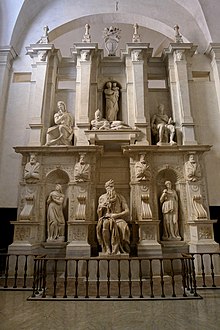
In 1505 Michelangelo was invited back to Rome by the newly elected Pope Julius Two and commissioned to build the Pope's tomb, which was to include 40 statues and exist finished in five years.[45] Under the patronage of the pope, Michelangelo experienced constant interruptions to his work on the tomb in order to accomplish numerous other tasks.
The committee for the tomb forced the artist to go out Florence with his planned Battle of Cascina painting unfinished.[46] [47] [48] Past this fourth dimension, Michelangelo was established every bit an artist;[49] both he and Julius II had hot tempers and soon argued.[47] [48] On 17 April 1506, Michelangelo left Rome in undercover for Florence, remaining there until the Florentine government pressed him to return to the pope.[48]
Although Michelangelo worked on the tomb for forty years, it was never finished to his satisfaction.[45] It is located in the Church of San Pietro in Vincoli in Rome and is about famous for the central figure of Moses, completed in 1516.[l] Of the other statues intended for the tomb, two, known as the Rebellious Slave and the Dying Slave, are now in the Louvre.[45]
Sistine Chapel ceiling, 1505–1512

Michelangelo painted the ceiling of the Sistine Chapel; the work took approximately four years to complete (1508–1512)
During the same period, Michelangelo painted the ceiling of the Sistine Chapel,[51] which took approximately iv years to complete (1508–1512).[50] According to Condivi's account, Bramante, who was working on the edifice of St. Peter's Basilica, resented Michelangelo's committee for the pope'due south tomb and convinced the pope to commission him in a medium with which he was unfamiliar, in order that he might neglect at the task.[52] Michelangelo was originally commissioned to paint the Twelve Apostles on the triangular pendentives that supported the ceiling, and to embrace the central part of the ceiling with ornament.[53] Michelangelo persuaded Pope Julius 2 to give him a complimentary paw and proposed a different and more complex scheme,[47] [48] representing the Creation, the Autumn of Man, the Promise of Salvation through the prophets, and the genealogy of Christ. The work is part of a larger scheme of decoration within the chapel that represents much of the doctrine of the Cosmic Church.[53]
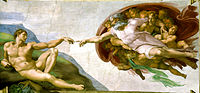
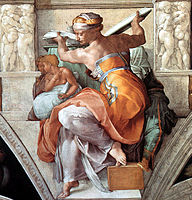
The limerick stretches over 500 square metres of ceiling[54] and contains over 300 figures.[53] At its centre are nine episodes from the Book of Genesis, divided into 3 groups: God'southward creation of the globe; God's creation of humankind and their autumn from God's grace; and lastly, the state of humanity equally represented past Noah and his family. On the pendentives supporting the ceiling are painted twelve men and women who prophesied the coming of Jesus, vii prophets of Israel, and 5 Sibyls, prophetic women of the Classical world.[53] Amongst the most famous paintings on the ceiling are The Creation of Adam, Adam and Eve in the Garden of Eden, the Drench, the Prophet Jeremiah, and the Cumaean Sibyl.
Florence under Medici popes, 1513 – early 1534
In 1513, Pope Julius Ii died and was succeeded by Pope Leo Ten, the second son of Lorenzo de' Medici.[l] From 1513 to 1516 Pope Leo was on good terms with Pope Julius'due south surviving relatives, so encouraged Michelangelo to continue work on Julius's tomb, merely the families became enemies once more in 1516 when Pope Leo tried to seize the Duchy of Urbino from Julius's nephew Francesco Maria I della Rovere.[55] Pope Leo so had Michelangelo stop working on the tomb, and deputed him to reconstruct the façade of the Basilica of San Lorenzo in Florence and to beautify information technology with sculptures. He spent iii years creating drawings and models for the façade, every bit well as attempting to open up a new marble quarry at Pietrasanta specifically for the project. In 1520, the work was abruptly cancelled past his financially strapped patrons earlier whatever real progress had been made. The basilica lacks a façade to this twenty-four hour period.[56]
In 1520, the Medici came dorsum to Michelangelo with some other yard proposal, this fourth dimension for a family funerary chapel in the Basilica of San Lorenzo.[50] For posterity, this projection, occupying the artist for much of the 1520s and 1530s, was more than fully realised. Michelangelo used his own discretion to create the limerick of the Medici Chapel, which houses the big tombs of ii of the younger members of the Medici family, Giuliano, Knuckles of Nemours, and Lorenzo, his nephew. It likewise serves to commemorate their more famous predecessors, Lorenzo the Magnificent and his brother Giuliano, who are cached nearby. The tombs display statues of the two Medici and emblematic figures representing Dark and Solar day, and Dusk and Dawn. The chapel likewise contains Michelangelo'south Medici Madonna.[57] In 1976 a concealed corridor was discovered with drawings on the walls that related to the chapel itself.[58] [59]
Pope Leo X died in 1521 and was succeeded briefly by the austere Adrian Six, and then by his cousin Giulio Medici as Pope Cloudless 7.[60] In 1524 Michelangelo received an architectural committee from the Medici pope for the Laurentian Library at San Lorenzo'southward Church building.[50] He designed both the interior of the library itself and its vestibule, a building utilising architectural forms with such dynamic event that it is seen as the forerunner of Baroque architecture. It was left to assistants to interpret his plans and carry out construction. The library was not opened until 1571, and the vestibule remained incomplete until 1904.[61]
In 1527, Florentine citizens, encouraged past the sack of Rome, threw out the Medici and restored the republic. A siege of the city ensued, and Michelangelo went to the aid of his beloved Florence by working on the city's fortifications from 1528 to 1529. The city fell in 1530, and the Medici were restored to power.[l] Michelangelo roughshod out of favour with the young Alessandro Medici, who had been installed as the starting time Duke of Florence. Fearing for his life, he fled to Rome, leaving administration to complete the Medici chapel and the Laurentian Library. Despite Michelangelo's support of the republic and resistance to the Medici rule, he was welcomed by Pope Clement, who reinstated an allowance that he had previously granted the creative person and made a new contract with him over the tomb of Pope Julius.[62]
Rome, 1534–1546

In Rome, Michelangelo lived near the church of Santa Maria di Loreto. It was at this fourth dimension that he met the poet Vittoria Colonna, marchioness of Pescara, who was to become one of his closest friends until her expiry in 1547.[63]
Shortly before his death in 1534, Pope Cloudless 7 commissioned Michelangelo to pigment a fresco of The Last Judgment on the altar wall of the Sistine Chapel. His successor, Pope Paul 3, was instrumental in seeing that Michelangelo began and completed the project, which he laboured on from 1534 to October 1541.[50] The fresco depicts the 2d Coming of Christ and his Sentence of the souls. Michelangelo ignored the usual artistic conventions in portraying Jesus, showing him as a massive, muscular effigy, youthful, beardless and naked.[64] He is surrounded by saints, amongst whom Saint Bartholomew holds a drooping flayed skin, bearing the likeness of Michelangelo. The dead rise from their graves, to exist consigned either to Sky or to Hell.[64]
In one case completed, the delineation of Christ and the Virgin Mary naked was considered sacrilegious, and Central Carafa and Monsignor Sernini (Mantua's ambassador) campaigned to have the fresco removed or censored, only the Pope resisted. At the Council of Trent, shortly before Michelangelo's expiry in 1564, it was decided to obscure the genitals and Daniele da Volterra, an amateur of Michelangelo, was commissioned to make the alterations.[65] An uncensored copy of the original, past Marcello Venusti, is in the Capodimonte Museum of Naples.[66]
Michelangelo worked on a number of architectural projects at this fourth dimension. They included a blueprint for the Capitoline Hill with its trapezoid piazza displaying the ancient bronze statue of Marcus Aurelius. He designed the upper floor of the Palazzo Farnese and the interior of the Church of Santa Maria degli Angeli, in which he transformed the vaulted interior of an Ancient Roman bathhouse. Other architectural works include San Giovanni dei Fiorentini, the Sforza Chapel (Capella Sforza) in the Basilica di Santa Maria Maggiore and the Porta Pia.[67]
St Peter's Basilica, 1546–1564

While withal working on the Last Judgment, Michelangelo received still another committee for the Vatican. This was for the painting of two large frescos in the Cappella Paolina depicting significant events in the lives of the two most of import saints of Rome, the Conversion of Saint Paul and the Crucifixion of Saint Peter. Like the Last Judgment, these two works are circuitous compositions containing a great number of figures.[68] They were completed in 1550. In the same year, Giorgio Vasari published his Vita, including a biography of Michelangelo.[69]
In 1546, Michelangelo was appointed architect of St. Peter's Basilica, Rome.[l] The process of replacing the Constantinian basilica of the fourth century had been underway for l years and in 1506 foundations had been laid to the plans of Bramante. Successive architects had worked on it, simply little progress had been made. Michelangelo was persuaded to take over the project. He returned to the concepts of Bramante, and developed his ideas for a centrally planned church building, strengthening the structure both physically and visually.[70] The dome, not completed until after his death, has been chosen by Banister Fletcher, "the greatest creation of the Renaissance".[71]
As structure was progressing on St Peter'south, there was concern that Michelangelo would pass abroad earlier the dome was finished. However, once building commenced on the lower role of the dome, the supporting ring, the completion of the design was inevitable.
On 7 Dec 2007, a scarlet chalk sketch for the dome of St Peter's Basilica, possibly the last made by Michelangelo before his decease, was discovered in the Vatican archives. Information technology is extremely rare, since he destroyed his designs later in life. The sketch is a partial plan for i of the radial columns of the cupola drum of Saint Peter's.[72]
Personal life


Faith
Michelangelo was a devout Cosmic whose faith deepened at the end of his life.[73] His poetry includes the following closing lines from what is known as poem 285 (written in 1554); "Neither painting nor sculpture will be able any longer to calm my soul, at present turned toward that divine dearest that opened his arms on the cross to take u.s.a. in." [74] [75]
Personal habits
Michelangelo was abstemious in his personal life, and once told his apprentice, Ascanio Condivi: "However rich I may have been, I accept always lived like a poor man."[76] Michelangelo'south bank accounts and numerous deeds of purchase show that his net worth was near fifty,000 gold ducats, more than many princes and dukes of his time.[77] Condivi said he was indifferent to food and drink, eating "more than out of necessity than of pleasure"[76] and that he "oftentimes slept in his clothes and ... boots."[76] His biographer Paolo Giovio says, "His nature was and then crude and uncouth that his domestic habits were incredibly squalid, and deprived posterity of any pupils who might take followed him."[78] This, yet, may not have afflicted him, every bit he was by nature a solitary and melancholy person, bizzarro e fantastico , a man who "withdrew himself from the company of men."[79]
Relationships and poetry
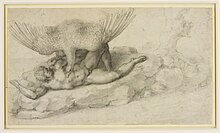
Information technology is incommunicable to know for certain whether Michelangelo had physical relationships (Condivi ascribed to him a "monk-like guiltlessness");[80] speculation almost his sexuality is rooted in his poetry.[81] He wrote over 3 hundred sonnets and madrigals. The longest sequence, displaying deep romantic feeling, was written to the young Roman patrician Tommaso dei Cavalieri (c. 1509–1587), who was 23 years old when Michelangelo first met him in 1532, at the age of 57.[82] [83] The Florentine Benedetto Varchi fifteen years later described Cavalieri as of "incomparable beauty", with "graceful manners, and so excellent an endowment and and so charming a demeanour that he indeed deserved, and still deserves, the more to be loved the improve he is known".[84] In his "Lives of the Artists", Giorgio Vasari observed: "But infinitely more than than any of the others he loved M. Tommaso de' Cavalieri, a Roman gentleman, for whom, being a fellow and much inclined to these arts, [Michelangelo] fabricated, to the end that he might acquire to draw, many well-nigh superb drawings of divinely beautiful heads, designed in blackness and scarlet chalk; and then he drew for him a Ganymede rapt to Heaven past Jove's Eagle, a Tityus with the Vulture devouring his heart, the Chariot of the Sun falling with Phaëthon into the Po, and a Bacchanal of children, which are all in themselves most rare things, and drawings the like of which have never been seen."[85] Scholars agree that Michelangelo became infatuated with Cavalieri.[86] The poems to Cavalieri make upward the first big sequence of poems in any modern natural language addressed by one homo to some other; they predate by 50 years Shakespeare'southward sonnets to the off-white youth:
I feel equally lit past fire a common cold countenance
That burns me from afar and keeps itself ice-chill;
A strength I feel two shapely arms to fill
Which without motion moves every balance.
-
- — (Michael Sullivan, translation)
Cavalieri replied: "I swear to render your love. Never accept I loved a man more than I dear you, never have I wished for a friendship more than than I wish for yours." Cavalieri remained devoted to Michelangelo until his decease.[87]
In 1542, Michelangelo met Cecchino dei Bracci who died merely a year later, inspiring Michelangelo to write 48 funeral epigrams. Some of the objects of Michelangelo'south affections, and subjects of his verse, took reward of him: the model Febo di Poggio asked for money in response to a love-poem, and a second model, Gherardo Perini, stole from him shamelessly.[87]
What some have interpreted as the seemingly homoerotic nature of the poesy has been a source of discomfort to later generations. Michelangelo's grandnephew, Michelangelo Buonarroti the Younger, published the poems in 1623 with the gender of pronouns changed,[88] and it was not until John Addington Symonds translated them into English in 1893 that the original genders were restored. In modernistic times some scholars insist that, despite the restoration of the pronouns, they represent "an emotionless and elegant re-imagining of Ideal dialogue, whereby erotic verse was seen equally an expression of refined sensibilities".[87]
Late in life, Michelangelo nurtured a great ideal love for the poet and noble widow Vittoria Colonna, whom he met in Rome in 1536 or 1538 and who was in her late forties at the time. They wrote sonnets for each other and were in regular contact until she died. These sonnets generally deal with the spiritual bug that occupied them.[89] Condivi recalls Michelangelo's saying that his sole regret in life was that he did not osculation the widow's face in the same manner that he had her paw.[63]
Feuds with other artists
In a letter from tardily 1542, Michelangelo blamed the tensions betwixt Julius Ii and himself on the envy of Bramante and Raphael, saying of the latter, "all he had in art, he got from me". According to Gian Paolo Lomazzo, Michelangelo and Raphael met in one case: the former was solitary, while the latter was accompanied past several others. Michelangelo commented that he thought he had encountered the main of police with such an aggregation, and Raphael replied that he thought he had met an executioner, every bit they are wont to walk solitary.[90]
Works
Madonna and Child
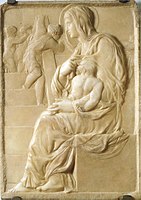
The Madonna of the Steps is Michelangelo'due south earliest known work in marble. Information technology is carved in shallow relief, a technique oftentimes employed by the master-sculptor of the early 15th century, Donatello, and others such equally Desiderio da Settignano.[91] While the Madonna is in contour, the easiest attribute for a shallow relief, the child displays a twisting motility that was to get feature of Michelangelo's piece of work. The Taddei Tondo of 1502 shows the Christ Child frightened by a Bullfinch, a symbol of the Crucifixion.[42] The lively class of the child was later adapted by Raphael in the Bridgewater Madonna. The Bruges Madonna was, at the time of its creation, unlike other such statues depicting the Virgin proudly presenting her son. Here, the Christ Child, restrained by his female parent'southward clasping hand, is about to step off into the earth.[92] The Doni Tondo, depicting the Holy Family, has elements of all three previous works: the frieze of figures in the background has the appearance of a depression-relief, while the circular shape and dynamic forms repeat the Taddeo Tondo. The twisting move nowadays in the Bruges Madonna is accentuated in the painting. The painting heralds the forms, motility and colour that Michelangelo was to employ on the ceiling of the Sistine Chapel.[42]
-
-

The Taddei Tondo (1502)
Male figure
The kneeling affections is an early work, i of several that Michelangelo created equally function of a big decorative scheme for the Arca di San Domenico in the church dedicated to that saint in Bologna. Several other artists had worked on the scheme, commencement with Nicola Pisano in the 13th century. In the tardily 15th century, the projection was managed by Niccolò dell'Arca. An affections holding a candlestick, by Niccolò, was already in place.[93] Although the two angels grade a pair, in that location is a great contrast between the two works, the i depicting a frail kid with flowing hair clothed in Gothic robes with deep folds, and Michelangelo's depicting a robust and muscular youth with eagle's wings, clad in a garment of Classical style. Everything nearly Michelangelo's angel is dynamic.[94] Michelangelo'southward Bacchus was a commission with a specified subject, the youthful God of Wine. The sculpture has all the traditional attributes, a vine wreath, a cup of wine and a fawn, but Michelangelo ingested an air of reality into the subject, depicting him with bleary eyes, a swollen bladder and a stance that suggests he is unsteady on his feet.[93] While the work is obviously inspired by Classical sculpture, information technology is innovative for its rotating motion and strongly three-dimensional quality, which encourages the viewer to await at it from every bending.[95]
In the so-called Dying Slave, Michelangelo over again utilised the effigy with marked contrapposto to suggest a item human state, in this example waking from sleep. With the Rebellious Slave, it is one of ii such earlier figures for the Tomb of Pope Julius 2, now in the Louvre, that the sculptor brought to an nigh finished land.[96] These ii works were to have a profound influence on later sculpture, through Rodin who studied them at the Louvre.[97] The Atlas Slave is 1 of the later figures for Pope Julius' tomb. The works, known collectively as The Captives, each show the figure struggling to gratis itself, every bit if from the bonds of the stone in which it is lodged. The works give a unique insight into the sculptural methods that Michelangelo employed and his mode of revealing what he perceived within the rock.[98]
-
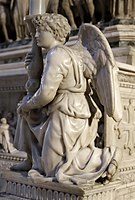
Angel past Michelangelo, early on work (1494–95)
-

Bacchus by Michelangelo, early work (1496–1497)
-

-

Sistine Chapel ceiling
The Sistine Chapel ceiling was painted between 1508 and 1512.[l] The ceiling is a flattened barrel vault supported on twelve triangular pendentives that rise from between the windows of the chapel. The commission, as envisaged by Pope Julius 2, was to beautify the pendentives with figures of the twelve apostles.[99] Michelangelo, who was reluctant to accept the chore, persuaded the Pope to give him a free hand in the composition.[100] The resultant scheme of decoration awed his contemporaries and has inspired other artists ever since.[101] The scheme is of nine panels illustrating episodes from the Book of Genesis, gear up in an architectonic frame. On the pendentives, Michelangelo replaced the proposed Apostles with Prophets and Sibyls who heralded the coming of the Messiah.[100]

The Sistine Chapel Ceiling (1508–1512)
Michelangelo began painting with the later episodes in the narrative, the pictures including locational details and groups of figures, the Drunkenness of Noah being the beginning of this grouping.[100] In the after compositions, painted later the initial scaffolding had been removed, Michelangelo made the figures larger.[100] I of the fundamental images, The Creation of Adam is ane of the best known and most reproduced works in the history of art. The final console, showing the Separation of Calorie-free from Darkness is the broadest in fashion and was painted in a unmarried 24-hour interval. As the model for the Creator, Michelangelo has depicted himself in the action of painting the ceiling.[100]
-

The Drunkenness of Noah
-

The Deluge (detail)
-
-

The Starting time Day of Creation
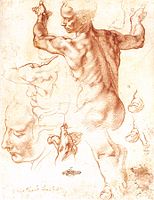
Every bit supporters to the smaller scenes, Michelangelo painted xx youths who have variously been interpreted as angels, as muses, or merely as decoration. Michelangelo referred to them as "ignudi".[102] The effigy reproduced may be seen in context in the above image of the Separation of Light from Darkness. In the process of painting the ceiling, Michelangelo made studies for unlike figures, of which some, such as that for The Libyan Sibyl have survived, demonstrating the care taken past Michelangelo in details such equally the hands and anxiety.[103] The Prophet Jeremiah, contemplating the downfall of Jerusalem, is an image of the artist himself.
-
Studies for The Libyan Sibyl
-
The Libyan Sibyl (1511)
-

The Prophet Jeremiah (1511)
-

Ignudo
Effigy compositions
Michelangelo'southward relief of the Battle of the Centaurs, created while he was even so a youth associated with the Medici University,[104] is an unusually complex relief in that it shows a great number of figures involved in a vigorous struggle. Such a complex disarray of figures was rare in Florentine art, where it would commonly only be found in images showing either the Massacre of the Innocents or the Torments of Hell. The relief handling, in which some of the figures are boldly projecting, may indicate Michelangelo's familiarity with Roman sarcophagus reliefs from the drove of Lorenzo Medici, and similar marble panels created past Nicola and Giovanni Pisano, and with the figurative compositions on Ghiberti'south Baptistry Doors.[ commendation needed ]
The composition of the Boxing of Cascina is known in its entirety only from copies,[105] as the original cartoon, according to Vasari, was and then admired that it deteriorated and was eventually in pieces.[106] It reflects the earlier relief in the free energy and diversity of the figures,[107] with many different postures, and many being viewed from the dorsum, as they turn towards the approaching enemy and ready for battle.[ citation needed ]
In The Final Judgment it is said that Michelangelo drew inspiration from a fresco by Melozzo da Forlì in Rome'south Santi Apostoli. Melozzo had depicted figures from dissimilar angles, as if they were floating in the Heaven and seen from below. Melozzo'south imperial figure of Christ, with windblown cloak, demonstrates a degree of foreshortening of the figure that had as well been employed by Andrea Mantegna, but was not usual in the frescos of Florentine painters. In The Last Judgment Michelangelo had the opportunity to describe, on an unprecedented scale, figures in the action of either rising heavenward or falling and being dragged down.[ citation needed ]
In the 2 frescos of the Pauline Chapel, The Crucifixion of St. Peter and The Conversion of Saul, Michelangelo has used the diverse groups of figures to convey a complex narrative. In the Crucifixion of Peter soldiers busy themselves about their assigned duty of excavation a post hole and raising the cantankerous while various people await on and talk over the events. A group of horrified women cluster in the foreground, while some other grouping of Christians is led past a alpine homo to witness the events. In the correct foreground, Michelangelo walks out of the painting with an expression of disillusionment.[ citation needed ]


Architecture
Michelangelo'due south architectural commissions included a number that were not realised, notably the façade for Brunelleschi's Church building of San Lorenzo in Florence, for which Michelangelo had a wooden model constructed, just which remains to this day unfinished rough brick. At the same church building, Giulio de' Medici (later Pope Cloudless VII) deputed him to pattern the Medici Chapel and the tombs of Giuliano and Lorenzo Medici.[108] Pope Clement too commissioned the Laurentian Library, for which Michelangelo likewise designed the extraordinary lobby with columns recessed into niches, and a staircase that appears to spill out of the library similar a flow of lava, according to Nikolaus Pevsner, "... revealing Mannerism in its most sublime architectural form."[109]
In 1546 Michelangelo produced the highly complex ovoid design for the pavement of the Campidoglio and began designing an upper storey for the Farnese Palace. In 1547 he took on the job of completing St Peter's Basilica, begun to a pattern past Bramante, and with several intermediate designs past several architects. Michelangelo returned to Bramante's design, retaining the basic form and concepts past simplifying and strengthening the design to create a more dynamic and unified whole.[110] Although the late 16th-century engraving depicts the dome as having a hemispherical profile, the dome of Michelangelo'south model is somewhat ovoid and the last product, as completed past Giacomo della Porta, is more so.[110]
-
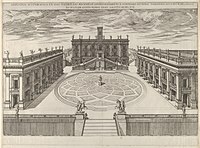
Michelangelo's redesign of the ancient Capitoline Colina included a complex spiralling pavement with a star at its centre.
-

Michelangelo'south design for St Peter's is both massive and contained, with the corners betwixt the apsidal artillery of the Greek Cross filled past square projections.
-

The exterior is surrounded by a giant lodge of pilasters supporting a continuous cornice. Iv minor cupolas cluster around the dome.
Terminal years
In his sometime historic period, Michelangelo created a number of Pietàs in which he apparently reflects upon mortality. They are heralded by the Victory, perhaps created for the tomb of Pope Julius II simply left unfinished. In this group, the youthful victor overcomes an older hooded figure, with the features of Michelangelo.
The Pietà of Vittoria Colonna is a chalk cartoon of a type described equally "presentation drawings", equally they might be given as a gift by an artist, and were not necessarily studies towards a painted work. In this paradigm, Mary'due south upraised arms and hands are indicative of her prophetic role. The frontal attribute is reminiscent of Masaccio'due south fresco of the Holy Trinity in the Basilica of Santa Maria Novella, Florence.
In the Florentine Pietà, Michelangelo again depicts himself, this time equally the anile Nicodemus lowering the torso of Jesus from the cross into the arms of Mary his mother and Mary Magdalene. Michelangelo smashed the left arm and leg of the figure of Jesus. His student Tiberio Calcagni repaired the arm and drilled a pigsty in which to set up a replacement leg which was non later attached. He likewise worked on the figure of Mary Magdalene.[111] [112]
The final sculpture that Michelangelo worked on (vi days before his decease), the Rondanini Pietà could never exist completed because Michelangelo carved information technology away until there was insufficient rock. The legs and a detached arm remain from a previous phase of the work. As it remains, the sculpture has an abstract quality, in keeping with 20th-century concepts of sculpture.[113] [114]
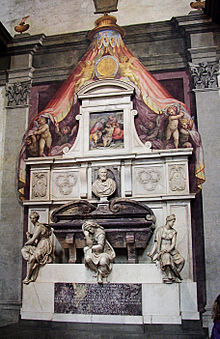
Michelangelo died in Rome in 1564, at the historic period of 88 (three weeks before his 89th birthday). His body was taken from Rome for interment at the Basilica of Santa Croce, fulfilling the maestro's concluding request to be buried in his beloved Florence.[115]
Michelangelo's heir Lionardo Buonarroti commissioned Giorgio Vasari to design and build the Tomb of Michelangelo, a awe-inspiring project that cost 770 scudi, and took over 14 years to consummate.[116] Marble for the tomb was supplied by Cosimo I de' Medici, Duke of Tuscany who had also organized a state funeral to honour Michelangelo in Florence.[116]
-
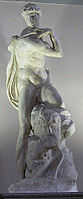
Statue of Victory (1534), Palazzo Vecchio, Florence
-

The Pietà of Vittoria Colonna (c. 1540)
In popular civilization
- Movies
- Vita di Michelangelo (1964)[117]
- The Agony and the Ecstasy (1965), directed by Ballad Reed and starring Charlton Heston as Michelangelo[118]
- A Season of Giants (1990)[119] [120] [121]
- Michelangelo - Countless (2018), starring Enrico Lo Verso as Michelangelo[122]
- Sin (2019), directed by Andrei Konchalovsky[123]
Legacy
Michelangelo, with Leonardo da Vinci and Raphael, is one of the three giants of the Florentine High Renaissance. Although their names are ofttimes cited together, Michelangelo was younger than Leonardo by 23 years, and older than Raphael past eight. Because of his reclusive nature, he had little to practise with either creative person and outlived both of them past more than than 40 years. Michelangelo took few sculpture students. He employed Francesco Granacci, who was his young man educatee at the Medici Academy, and became one of several administration on the Sistine Chapel ceiling.[53] Michelangelo appears to have used assistants mainly for the more manual tasks of preparing surfaces and grinding colours. Despite this, his works were to have a cracking influence on painters, sculptors and architects for many generations to come up.
While Michelangelo's David is the most famous male person nude of all time and at present graces cities around the world, some of his other works have had peradventure even greater bear upon on the course of art. The twisting forms and tensions of the Victory, the Bruges Madonna and the Medici Madonna make them the heralds of the Mannerist fine art. The unfinished giants for the tomb of Pope Julius 2 had profound effect on late-19th- and 20th-century sculptors such equally Rodin and Henry Moore.
Michelangelo's foyer of the Laurentian Library was i of the earliest buildings to utilise Classical forms in a plastic and expressive manner. This dynamic quality was later to detect its major expression in Michelangelo's centrally planned St Peter'south, with its giant order, its rippling cornice and its upwards-launching pointed dome. The dome of St Peter's was to influence the building of churches for many centuries, including Sant'Andrea della Valle in Rome and St Paul's Cathedral, London, also as the civic domes of many public buildings and the state capitals across America.
Artists who were directly influenced by Michelangelo include Raphael, whose monumental treatment of the effigy in the School of Athens and The Expulsion of Heliodorus from the Temple owes much to Michelangelo, and whose fresco of Isaiah in Sant'Agostino closely imitates the older master's prophets.[124] Other artists, such as Pontormo, drew on the writhing forms of the Terminal Judgment and the frescoes of the Capella Paolina.[125]
The Sistine Chapel ceiling was a work of unprecedented grandeur, both for its architectonic forms, to be imitated past many Baroque ceiling painters, and also for the wealth of its creativity in the study of figures. Vasari wrote:
The piece of work has proved a veritable beacon to our art, of inestimable do good to all painters, restoring light to a earth that for centuries had been plunged into darkness. Indeed, painters no longer demand to seek for new inventions, novel attitudes, clothed figures, fresh ways of expression, different arrangements, or sublime subjects, for this work contains every perfection possible under those headings.[106]
Encounter also
- Michelangelo and the Medici
- Michelangelo phenomenon
- Nicodemite
- Italian Renaissance painting
- Restoration of the Sistine Chapel frescoes
- The Desperation and the Ecstasy
- The Titan: Story of Michelangelo (1950 documentary)
Footnotes
- a. ^ Michelangelo'southward father marks the date equally 6 March 1474 in the Florentine mode ab Incarnatione. Still, in the Roman manner, ab Nativitate, it is 1475.
- b. ^ Sources disagree as to how quondam Michelangelo was when he departed for school. De Tolnay writes that information technology was at 10 years sometime while Sedgwick notes in her translation of Condivi that Michelangelo was seven.
- c. ^ The Strozzi family acquired the sculpture Hercules. Filippo Strozzi sold it to Francis I in 1529. In 1594, Henry 4 installed it in the Jardin d'Estang at Fontainebleau where it disappeared in 1713 when the Jardin d'Estange was destroyed.
- d. ^ Vasari makes no mention of this episode and Paolo Giovio'south Life of Michelangelo indicates that Michelangelo tried to pass the statue off as an antique himself.
References
- ^ Wells, John (three April 2008). Longman Pronunciation Dictionary (3rd ed.). Pearson Longman. ISBN978-1-4058-8118-0.
- ^ a b c Michelangelo at the Encyclopædia Britannica
- ^ Symonds, John (nine Jan 2019). The Life of Michelangelo. BookRix. ISBN9783736804630 – via Google Books.
- ^ Vasari, Giorgio (14 August 2008). The Lives of the Artists. Oxford University Press. ISBN9780199537198 – via Google Books.
- ^ Hughes, A., & Elam, C. (2003). "Michelangelo". Oxford Fine art Online. Retrieved fourteen April 2018, from http://www.oxfordartonline.com
- ^ Smithers, Tamara. 2016. Michelangelo in the New Millennium: Conversations about Creative Do, Patronage and Christianity. Boston: Brill. p. 7. ISBN 978-90-04-31362-0.
- ^ Emison, Patricia. A (2004). Creating the "Divine Creative person": from Dante to Michelangelo. Brill. ISBN978-90-04-13709-7.
- ^ Art and Illusion, Eastward.H. Gombrich, ISBN 978-0-691-07000-one
- ^ Unione Montana dei Comuni della Valtiberina Toscana, www.cm-valtiberina.toscana.it
- ^ a b c J. de Tolnay, The Youth of Michelangelo, p. xi
- ^ a b C. Clément, Michelangelo, p. 5
- ^ A. Condivi, The Life of Michelangelo, p. 5
- ^ a b A. Condivi, The Life of Michelangelo, p. 9
- ^ a b Coughlan, Robert; (1978), The World of Michelangelo, Fourth dimension-Life; pp. xiv–xv
- ^ a b c Coughlan, pp. 35–40
- ^ Giovanni Fanelli, (1980) Brunelleschi, Becocci Firenze, pp. 3–x
- ^ H. Gardner, p. 408
- ^ a b Coughlan, pp. 28–32
- ^ R. Liebert, Michelangelo: A Psychoanalytic Study of his Life and Images, p. 59
- ^ C. Clément, Michelangelo, p. 7
- ^ C. Clément, Michelangelo, p. 9
- ^ J. de Tolnay, The Youth of Michelangelo, pp. xviii–19
- ^ a b A. Condivi, The Life of Michelangelo, p. 15
- ^ Coughlan, p. 42
- ^ a b J. de Tolnay, The Youth of Michelangelo, pp. 20–21
- ^ A. Condivi, The Life of Michelangelo, p. 17
- ^ Laurenzo, Domenico (2012). Art and Anatomy in Renaissance Italy: Images from a Scientific Revolution. Metropolitan Museum of Fine art. p. fifteen. ISBN 1588394565.
- ^ Zeybek, A.; Özkan, M. (August 2019). "Michelangelo and Anatomy". Anatomy: International Periodical of Experimental & Clinical Beefcake. 13 (Supplement 2): S199.
- ^ Coughlan, Robert (1966). The Earth of Michelangelo: 1475–1564 . et al. Time-Life Books. p. 67.
- ^ Bartz and König, p. 54
- ^ Miles Unger, Michelangelo: a Life in Six Masterpieces, ch. 1
- ^ a b J. de Tolnay, The Youth of Michelangelo, pp. 24–25
- ^ A. Condivi, The Life of Michelangelo, pp. 19–20
- ^ J. de Tolnay, The Youth of Michelangelo, pp. 26–28
- ^ a b Hirst and Dunkerton pp. 47–55
- ^ Vasari, Lives of the painters: Michelangelo
- ^ Paoletti and Radke, pp. 387–89
- ^ Goldscheider, p. 10
- ^ Marinazzo, Adriano (2020). "Una nuova possible attribuzione a Michelangelo. Il Volto Misterioso". Art e Dossier. 379: 76–81.
- ^ "Avant Banksy et Invader, Michel-Ange pionnier du street art dans les rues de Florence". LEFIGARO (in French). 22 November 2020. Retrieved xi Apr 2021.
- ^ Paoletti and Radke, pp. 392–93
- ^ a b c Goldscheider, p. eleven
- ^ Hirst and Dunkerton, p. 127
- ^ Hirst and Dunkerton, pp. 83–105, 336–46
- ^ a b c Goldscheider, pp. xiv–xvi
- ^ Chilvers, Ian, ed. (2009). "Michelangelo (Michelangelo Buonarroti)". The Oxford Dictionary of Art and Artists (4th ed.). Online: Oxford University Press. doi:10.1093/acref/9780199532940.001.0001. ISBN978-0-19-953294-0.
- ^ a b c Campbell, Gordon, ed. (2005). "Michelangelo Buonarroti or Michelagnolo Buonarroti". The Oxford Dictionary of the Renaissance (Online ed.). Oxford Academy Press. doi:ten.1093/acref/9780198601753.001.0001. ISBN978-0-xix-860175-3.
- ^ a b c d Osborne, Harold; Brigstocke, Hugh (2003). "Michelangelo Buonarroti". In Brigstocke, Hugh (ed.). The Oxford Companion to Western Art (Online ed.). Oxford University Press. doi:ten.1093/acref/9780198662037.001.0001. ISBN978-0-nineteen-866203-7.
- ^ Pater, Walter (1893). The Renaissance: Studies in Fine art and Poetry (fourth ed.). Courier Corporation [2005, 2013 reprint]. p. 55. ISBN978-0-486-14648-5.
- ^ a b c d east f g h i Bartz and König, p. 134
- ^ Marinazzo, Adriano (2018). "La Tomba di Giulio II e l'architettura dipinta della volta della Sistina". Art due east Dossier. 357: 46–51. ISSN 0394-0179.
- ^ Coughlan, p. 112
- ^ a b c d e Goldscheider, pp. 12–14
- ^ Bartz and König, p. 43
- ^ Miles Unger, Michelangelo: a Life in Six Masterpieces, ch. 5
- ^ Coughlan, pp. 135–36
- ^ Goldscheider, pp. 17–18
- ^ Peter Barenboim, Sergey Shiyan, Michelangelo: Mysteries of Medici Chapel, SLOVO, Moscow, 2006. ISBN 5-85050-825-two
- ^ Peter Barenboim, "Michelangelo Drawings – Key to the Medici Chapel Estimation", Moscow, Letny Sad, 2006, ISBN 5-98856-016-iv
- ^ Coughlan, pp. 151–52
- ^ Bartz and König, p. 87
- ^ Coughlan, pp. 159–61
- ^ a b A. Condivi (ed. Hellmut Wohl), The Life of Michelangelo, p. 103, Phaidon, 1976.
- ^ a b Bartz and König, pp. 100–02
- ^ Bartz and König, pp. 102, 109
- ^ Goldscheider, pp. 19–20
- ^ Goldscheider, pp. 8, 21, 22
- ^ Bartz and Kŏnig, p. 16
- ^ Ilan Rachum, The Renaissance, an Illustrated Encyclopedia, Octopus (1979) ISBN 0-7064-0857-8
- ^ Gardner, pp. 480–81
- ^ Banister Fletcher, 17th ed. p. 719
- ^ "Michelangelo 'last sketch' found". BBC News. seven Dec 2007. Retrieved 9 February 2009.
- ^ "Crucifixion by Michelangelo, a drawing in black chalk". The British Museum. Archived from the original on 15 October 2015. Retrieved 24 October 2018.
- ^ "Michelangelo, Selected Poems" (PDF). Columbia Academy. p. 20. Retrieved 24 October 2018.
- ^ "Michelangelo'due south Poesy". Michelangelo Gallery. Translated by Longfellow, H.Westward. Studio of the S. Retrieved 24 October 2018.
- ^ a b c Condivi, The Life of Michelangelo, p. 106.
- ^ Shirbon, Estelle. "Michelangelo more a prince than a pauper". LA Times.
{{cite news}}: CS1 maint: url-status (link) - ^ Paola Barocchi (ed.) Scritti d'arte del cinquecento, Milan, 1971; vol. I p. 10.
- ^ Condivi, p. 102.
- ^ Hughes, Anthony, "Michelangelo", p. 326. Phaidon, 1997.
- ^ Scigliano, Eric: "Michelangelo'due south Mountain; The Quest for Perfection in the Marble Quarries of Carrara" Archived 30 June 2009 at the Wayback Machine, Simon and Schuster, 2005. Retrieved 27 January 2007
- ^ Zöllner, Frank; Thoenes, Christof (2019). Michelangelo, 1475–1564: The Complete Paintings, Sculptures and Architecture. Translated past Karen Williams (second ed.). Cologne: Taschen. pp. 381, 384, 387–390. ISBN978-3-8365-3716-2. OCLC 1112202167.
- ^ Bredekamp, Horst (2021). Michelangelo (in German). Verlag Klaus Wagenbach. Berlin. pp. 466–486. ISBN978-three-8031-3707-iv. OCLC 1248717101.
- ^ Gayford 2013
- ^ Vasari, Giorgio (1914). Lives of the most eminent painters, sculptors, and architects. Vol. 9. Translated by Gaston du C. De Vere. London: Medici Gild. pp. 105–106.
- ^ Co-ordinate to Gayford (2013), "Any the strength of his feelings, Michelangelo's relationship with Tommaso de'Cavalieri is unlikely to have been a physical, sexual affair. For 1 thing, it was acted out through poems and images that were far from secret. Even if nosotros do not choose to believe Michelangelo'southward protestations of the chastity of his behaviour, Tommaso's high social position and the relatively public nature of their relationship make information technology improbable that it was not platonic."
- ^ a b c Hughes, Anthony: "Michelangelo", p. 326. Phaidon, 1997.
- ^ Rictor Norton, "The Myth of the Modern Homosexual", p. 143. Cassell, 1997.
- ^ Vittoria Colonna, Sonnets for Michelangelo. A Bilingual Edition edited and translated past Abigail Brundin, The Academy of Chicago Printing 2005. ISBN 0-226-11392-2, p. 29.
- ^ Salmi, Mario; Becherucci, Luisa; Marabottini, Alessandro; Tempesti, Anna Forlani; Marchini, Giuseppe; Becatti, Giovanni; Castagnoli, Ferdinando; Golzio, Vincenzo (1969). The Complete Piece of work of Raphael. New York: Reynal and Co., William Morrow and Company. pp. 587, 610.
- ^ Bartz and König, p. 8
- ^ Bartz and König, p. 22
- ^ a b Goldscheider, p. 9
- ^ Hirst and Dunkerton, pp. 20–21
- ^ Bartz and König, pp. 26–27
- ^ Bartz and König, pp. 62–63
- ^ Yvon Taillandier, Rodin, New York: Crown Trade Paperbacks, (1977) ISBN 0-517-88378-3
- ^ Coughlan, pp. 166–67
- ^ Goldscieder p. 12
- ^ a b c d e Paoletti and Radke, pp. 402–03
- ^ Vasari, et al.
- ^ Bartz and König
- ^ Coughlan
- ^ J. de Tolnay, The Youth of Michelangelo, p. 18
- ^ Goldscheider, p. eight
- ^ a b Giorgio Vasari, Lives of the Artists: Michelangelo
- ^ J. de Tolnay, The Youth of Michelangelo, p. 135
- ^ Goldscheider
- ^ Nikolaus Pevsner, An Outline of European Compages, Pelican, 1964
- ^ a b Gardner
- ^ Maiorino, Giancarlo, 1990. The Cornucopian Mind and the Baroque Unity of the Arts. Penn State Press. p. 28. ISBN 0-271-00679-10.
- ^ Di Cagno, Gabriella. 2008. Michelangelo. Oliver Press. p. 58. ISBN one-934545-01-v.
- ^ Tolnay, Charles de. 1960. Michelangelo.: V, The Final Period: Last Judgment. Frescoes of the Pauline Chapel. Final Pietas Princeton: Princeton Univ. Press. p. 154. OCLC 491820830.
- ^ Crispina, Enrica. 2001. Michelangelo. Firenze: Giunti. p. 117. ISBN 88-09-02274-ii.
- ^ Coughlan, p. 179
- ^ a b "Michelangelo's tomb: five fun facts you probably didn't know". The Florentine. 12 October 2017. Retrieved 20 May 2021.
- ^ "Vita di Michelangelo". imdb.com. 13 Dec 1964. Retrieved 29 November 2019.
- ^ Rock, Irving (1961). The Agony and the Ecstasy: A Biographical Novel of Michelangelo . ISBN0451171357.
- ^ Ken Tucker (xv March 1991). "A Season of Giants (1991)". Amusement Weekly . Retrieved 11 July 2014.
- ^ Hal Erickson (2014). "A Season of Giants (1991)". Movies & Tv set Dept. The New York Times. Archived from the original on sixteen July 2014. Retrieved eleven July 2014.
- ^ VV.AA. (March 1994). Variety Boob tube Reviews, 1991–1992. Taylor & Francis, 1994. ISBN0824037960.
- ^ "Michelangelo – Endless". filmitalia.org. Retrieved 29 November 2019.
- ^ "Il Peccato, 2019" (in Russian). kinopoisk.ru. Retrieved 29 November 2019.
- ^ Ettlinger, Leopold David, and Helen Southward. Ettlinger. 1987. Raphael. Oxford: Phaidon. pp. 91, 102, 122. ISBN 0-7148-2303-1.
- ^ Acidini Luchinat, Cristina. 2002. The Medici, Michelangelo, and the Art of Late Renaissance Florence. New Haven: Yale University Press in association with the Detroit Constitute of Arts. p. 96. ISBN 0-300-09495-7.
Sources
- Bartz, Gabriele; Eberhard König (1998). Michelangelo. Könemann. ISBN978-three-8290-0253-0.
- Clément, Charles (1892). Michelangelo . Harvard University: S. Low, Marston, Searle, & Rivington, ltd.: London.
michelangelo.
- Condivi, Ascanio; Alice Sedgewick (1553). The Life of Michelangelo. Pennsylvania Land University Press. ISBN978-0-271-01853-9.
- Goldscheider, Ludwig (1953). Michelangelo: Paintings, Sculptures, Architecture. Phaidon.
- Goldscheider, Ludwig (1953). Michelangelo: Drawings. Phaidon.
- Gardner, Helen; Fred S. Kleiner, Christin J. Mamiya, Gardner's Art through the Ages. Thomson Wadsworth, (2004) ISBN 0-15-505090-7.
- Hirst, Michael and Jill Dunkerton. (1994) The Young Michelangelo: The Creative person in Rome 1496–1501. London: National Gallery Publications, ISBN one-85709-066-7
- Liebert, Robert (1983). Michelangelo: A Psychoanalytic Report of his Life and Images. New Haven and London: Yale Academy Printing. ISBN978-0-300-02793-8.
- Paoletti, John T. and Radke, Gary M., (2005) Art in Renaissance Italian republic, Laurence King, ISBN 1-85669-439-9
- Tolnay, Charles (1947). The Youth of Michelangelo . Princeton, NJ: Princeton University Printing.
Further reading
- Ackerman, James (1986). The Compages of Michelangelo. University of Chicago Press. ISBN978-0-226-00240-8.
- Baldini, Umberto; Liberto Perugi (1982). The Sculpture of Michelangelo. Rizzoli. ISBN978-0-8478-0447-iv.
- Barenboim, Peter (with Shiyan, Sergey). Michelangelo in the Medici Chapel: Genius in Details (in English & Russian), LOOM, Moscow, 2011. ISBN 978-5-9903067-i-4
- Barenboim, Peter (with Heath, Arthur). Michelangelo's Moment: The British Museum Madonna, LOOM, Moscow, 2018.
- Barenboim, Peter (with Heath, Arthur). 500 years of the New Sacristy: Michelangelo in the Medici Chapel, LOOM, Moscow, 2019. ISBN 978-5-906072-42-9
- Carden, Robert Westward. (1913). Michelangelo: A Record of His Life equally Told in His Ain Letters and Papers. Constable and Visitor Ltd., London; reprinted by Legare Street Press, 2021.
- Einem, Herbert von (1973). Michelangelo. Trans. Ronald Taylor. London: Methuen.
- Gayford, Martin (2013). Michelangelo: His Ballsy Life. London: Penguin Books. ISBN978-0-141-93225-5.
- Gilbert, Creighton (1994). Michelangelo: On and Off the Sistine Ceiling. New York: George Braziller.
- Hartt, Frederick (1987). David past the Mitt of Michelangelo—the Original Model Discovered, Abbeville, ISBN 0-89659-761-X
- Hibbard, Howard (1974). Michelangelo. New York: Harper & Row.
- Néret, Gilles (2000). Michelangelo . Taschen. ISBN978-three-8228-5976-half dozen.
- Pietrangeli, Carlo, et al. (1994). The Sistine Chapel: A Glorious Restoration. New York: Harry N. Abrams
- Rolland, Romain (2009). Michelangelo. BiblioLife. ISBN978-1-110-00353-2.
- Ryan, Chris (2000). "Poems for Tommaso Cavalieri, Poems for Vittoria Colonna". The Poetry of Michelangelo: An Introduction. London: Bloomsbury Publishing. pp. 94–154. ISBN9780567012012.
- Sala, Charles (1996). Michelangelo: Sculptor, Painter, Architect. Editions Pierre Terrail. ISBN978-2-87939-069-7.
- Saslow, James M. (1991). The Verse of Michelangelo: An Annotated Translation. New Haven and London: Yale University Press.
- Seymour, Charles, Jr. (1972). Michelangelo: The Sistine Chapel Ceiling. New York: West.W. Norton.
- Stone, Irving (1987). The Agony and the Ecstasy. Signet. ISBN978-0-451-17135-one.
- Summers, David (1981). Michelangelo and the Language of Art. Princeton University Press.
- Symonds, John Addington (1893). The Life of Michelangelo Buonarroti, John C. Nimmo; reprinted by The Modern Library, Random House, 1927.
- Tolnay, Charles de. (1964). The Art and Thought of Michelangelo. 5 vols. New York: Pantheon Books.
- Wallace, William East. (2011). Michelangelo: The Artist, the Man and his Times. Cambridge University Press. ISBN978-1-107-67369-4.
- Wallace, William E. (2019). Michelangelo, God's Builder: The Story of His Final Years and Greatest Masterpiece. Princeton Academy Press, ISBN 978-0-691-19549-0
- Wilde, Johannes (1978). Michelangelo: Half-dozen Lectures. Oxford: Clarendon Printing.
External links
- The Digital Michelangelo Project
- Works by Michelangelo at Project Gutenberg
- Works by or about Michelangelo at Cyberspace Archive
- Works past Michelangelo at LibriVox (public domain audiobooks)

- Michelangelo at the Mathematics Genealogy Projection
- The BP Special Exhibition Michelangelo Drawings – closer to the master
- Michelangelo's Drawings: Real or Simulated? How to determine if a drawing is by Michelangelo.
- "Michelangelo: The Man and the Myth"
Source: https://en.wikipedia.org/wiki/Michelangelo
0 Response to "Discuss the Change in Micaelangelos Early and Later Art"
Post a Comment